Sunday, October 21, 2012

Deep-fried Brussels Sprouts


I haven't met so many people who go crazy about Brussels sprouts, have you? Join the club, then. They're OK for me but they are on my blacklist of veggies which make me gassy so they aren't usually on the weekly grocery shopping list. Anyways, I happened to buy them last week, but broke the habit this time. Instead of stewing or stir-frying them, I deep-fried them turning these super healthy vegetables into something unhealthy. What about the result? Well, I ate up all the crispy and so super yummy sprouts with some yogurt with minced garlic inside. If you ever want to make a change while cooking Brussels sprouts, then try this. You won't regret.
Ingredients

Brussels sprouts
1 cup all-purpose flour
1/2 cup cornmeal
1/2 teaspoon baking soda
1 large egg
2-4 cups vegetable oil
salt and pepper
soy sauce or yogurt with minced garlic for dipping

Directions

1. Stew the sprouts for 10-15 minutes. Remember to add some salt to the boiling water. 
2. Meanwhile, whisk the flour, cornmeal, salt, pepper and baking soda in a large bowl. In another bowl, whisk the egg with a pinch of salt. 
3. Once the sprouts are done, strain them and put them on a paper towel to dry.
4. Heat the oil in a deep stockpot over high heat. 
5. Dip sprouts in egg mixture first, then in flour-cornmeal mixture and then to the egg mixture again to coat. 
6. Submerge very carefully in oil. 
7. Fry for about 2-3 minutes, or until golden brown, and use a slotted spoon to transfer to a paper towel lined plate. 
8. Serve hot with soy sauce or yogurt with minced garlic inside  for dipping.

Saturday, October 20, 2012

Tuhafija: walnut stuffed apples


Tufahija is a popular Bosnian specialty which you can find in bakery shops and cafes all year long in Sarajevo. However, it's more popular when muslim Bosnian people celebrate Eid al-Fitr and Eid al-Adha and so it's made in a lot of houses on these special days. The main reason why the dessert is so popular is it's much lighter in calories than its rivals like baklava, ružica and hurmašica which are served with syrup. Another reason why tufahija is so popular is that, although lighter in calories, it still offers a great pleasure with its irresistible filling: walnuts and whipped cream. When you order a tufahija in any cafes here, it usually looks like this:


Traditionally, apples are peeled and cored, poached in syrup and served with a mixture of whipped cream and walnuts. (I will post the traditional tufahija recipe soon by the way).
                                                                                                                                                                                      This time, instead, I didn't peel the apples in order to make them keep all the flavour inside the skin. Then I baked the apples in the oven wrapped up in aluminum foil with cloves instead of boiling them in syrup which consists perhaps more than a kilogram of sugar. This way, the apples turned out much more lighter and they looked so natural in the end. The addition of ground cinnamon was a must for me as a cinnamon lover and it went along very well with the taste of the baked apples. By the way, the skin of the apples came off very easily after they were baked. Anyways, here comes the recipe of Mehtap's Tufahija. 


Ingredients
4 medium golden delicious apples
4 tablespoons sugar
4-5 tablespoons ground walnuts
8 cloves 
cinnamon
whipped cream 
aluminum foil

Directions
o. Preheat the oven at 200°C. 
1. Wash the apples and cut the tops off, but keep them aside. 2. Cut out the core. Remove all the seeds and a little more. Be careful not to make any holes at the bottom. 
3. Fill each apple with 1 tablespoon of sugar and sprinkle with some ground cinnamon.
4.  Place the tops of the apples back.
5. Wrap each apple in aluminum foil with two cloves. 
6. Bake in the oven for 35-40 minutes.
7. Let the apples cool down completely.
8. Meanwhile, mix some cream until thick and blend it ground walnuts.
9. Stuff each apple (when they are cool enough to handle) with walnut-cream mixture and put the tops back.
10. Chill in the refrigerator until ready to serve. 
11. Serve the apples cold in individual bowls topped with some extra whipped cream.

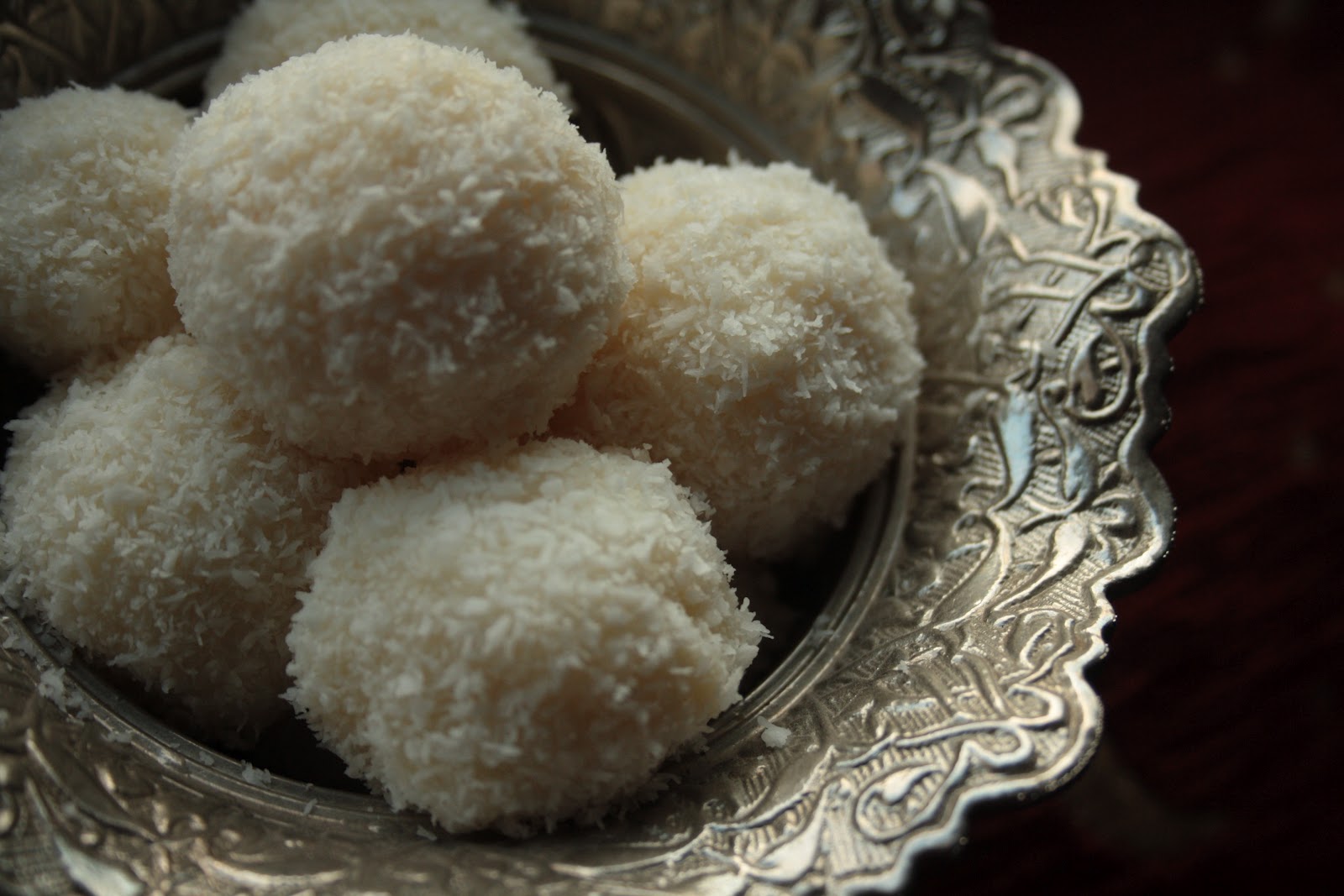
Raffaelo or the Sultan's Delight


"Raffaello was introduced in 1989. So white and refined, it reveals a light and delicate taste whose uniqueness is surprising.Tasting Raffaello means diving into a unique recipe, where a whole almond is plunged into a delicious creamy filling and enclosed in a crispy shell, covered in flakes of coconut. Raffaello, the only pleasure that transports you to a carefree world."

This is how Raffaelo is described on the website of Ferrero International S.A.  at http://www.ferrero.com/fc-1259/.  So little is left for me to say about this internationally advertised product as coconut and almond lovers would easily appreciate.

Well, I didn't have any intentions to clone or, let's be modest,  attempt to clone Raffaelo at all until I was handed a magazine on the plane by the stewardess on our way to Fethiye in Turkey. I was scannning through the pages of the magazine hastily out of  habit when I saw the photograph of cloned Raffaelos. They were given a totally irrelevant name such as "The Sultan's delight" which was probably meant to catch the tourist's eye. Whatever the intention was, its spell worked on me. After weeks, I was able to find the time to give it a try. However, the recipe needed some edits and additions. Since I know how things go with milk puddings, I decided to add some more ingredients: ground almonds. I think, as it was for the Raffaelo description I quoted above, instead of killing myself to find the correct words to describe the flavour and pleasure I enjoyed eating them, you should clear away everything on the counter and try it for yourself. They aren't, no doubt, close to the original. However, they were wonderful as the way they came out.  Here comes the recipe: 

Ingredients

1 litre milk
125 grams butter
1 cup flour 
1 cup sugar
2 teaspoons vanilla sugar
1 tablespoon honey
1/2 cup ground almonds
2 cups desiccated coconut for rolling

Directions

1. Mix sugar, flour and vanilla extract in a bowl.
2. Transfer the mixture into a medium saucepan and add in milk.
3. Stir constantly over medium heat and bring it to a boil. 
4. Add in the butter, honey and ground almonds. Continue stirring. The consistency gets thicker as you stir and the mixture stiffens to be rolled into balls.
5. Keep simmering for another 3-4 minutes.
6. Remove from heat and let it cool down completely in room temperature. Then, refrigerate it at for least 3 hours. As it showed, it's better if you refrigerate the pudding overnight.
7.  Mold 1  heaped teaspoon of the mixture into a ball and then roll in the coconut. 
8. Place the balls separately on a tray and refrigerate them again so they get firmer. 


After this first attempt, I realized that they could get closer to the original, if coated in melted white chocolate and then rolled in desiccated coconut.


Friday, October 5, 2012

Chewing Gum with Cinnamon: Smile


Cinnamon has been always my favourite and Emir showed up one evening in Istanbul with this packet of chewing gum from Iran. I still do not know how on Earth he was able to find it but he definitely made my day. It's the first time I'd tried some chewing gum with my favourite flavour and I liked it right away. Believe me, it's good to know people somewhere out there make an effort to make cinnamon-freaks smile! 


Sunday, September 30, 2012

Delicious Autumn


    Delicious autumn! My very soul is wedded to it, and if I were a bird I would fly about the earth seeking the successive autumns.
    George Eliot

Friday, September 28, 2012

A Disappointing God

One of my cousins has been waiting for years to get married to the 'Prince Charming' that hasn't popped up yet. When I visited them in Istanbul last month, her younger sister showed us the doll she's been keeping for years (symbolizing her long wait in expectation and the disappointment that's followed) and made fun of her. When I looked at the doll, I felt so confused and didn't know what to say. I just stared at it and shot a couple of photos.  Perhaps, it's just me and my beautiful mind that still make me feel so sad about that doll. Weeks after our visit to my cousins, I remembered this poem by Emily Dickinson. 


There comes an hour when begging stops,
When the long interceding lips
Perceive their prayer is vain.
"Thou shalt not" is a kinder sword
Than from a disappointing God
"Disciple, call again." 


Friday, September 21, 2012

Prickly Pears in Karmylassos

While we were enjoying ourselves in Istanbul, we had the opportunity to visit a dear friend in Fethiye, Mugla. During the three days we spent there, I realized there's only so much you can do on one holiday in that fascinating ancient town. On the day we visited Karmylassos / Kayakoy, I was full of different emotions which made this haunting and magical town look even more interesting to me. While we were wandering among the remains of the stone houses, an old lady handed us a yellow-orange coloured something that I hadn't seen before. 


My friend told us it's a local fruit the ladies in Kayakoy sell to make some money during the summer season. Well, it was the prickly pear as I was to learn later. Some of the common local names for the fruit and the plant are ''dikenli incir'', ''Hint inciri'' and ''Frenk inciri" as it also varies in English as Indian fig opuntia, barbary fig, and prickly pear. The thick outer skin is peeled and the flesh which is juicy and sweet is eaten usually after being refrigerated. I liked it right away. 


After a few clicks, I learned it is a species grown in dry areas of the world such as Mexico, Spain, Sicily, and the coasts of Southern Italy, Greece, Libya, Tunisia, Morocco, Algeria, Egypt, Saudi Arabia, Yemen, Israel, Chile, Brazil, Eritrea, Ethiopia, as well as Turkey.  


a prickly pear seller in Morocco

Wednesday, September 12, 2012

The Ladybird in the Garden


Until I decided to post this photograph, I did not know that ladybirds, apart from being a welcome sight in the garden, are natural enemies of many insect pests and the most popular and widely used beneficial insects around the world. What is more, it was surprising to read how gardeners do that: They just buy and release ladybirds (as adults or larvae) in their garden, boost their numbers and basically help nature help them control pests while ladybirds happily munch away on tasty pests.

Wednesday, September 5, 2012

The Swing Ride Nostalgia


On the second day of Eid we went to our old neigbourhood and visited some relatives and old neighbours. While we were walking in one of those familiar streets, I didn't know that I would come across the very same swing ride my sister and I used to enjoy as little kids. A wave of nostalgia swept over us when we saw it which made my sister burst out with childhood memories instantly. The man was the very same man who used to turn the handle of the ride's carriage while we were whirling around. We used to beg him, we remembered, to turn it faster and faster because the faster he turned it the faster we whirled. The man then would fold and carry the swing ride home after it got dark. 

My sister and I told the man that we wanted to give it a try but of course this time it was Milou and her cousins' turn to enjoy it. While they were doing so, we had a short chat with the man and learned that he has been doing this job for the last 25 years struggling to make a living. Interestingly, he survived despite all the malls around with playgrounds that offer futuristic mixtures of attractions for children. 

The man, then, folded the ride's carriage and headed for other streets leaving my sister and me with pleasure and sadness that he caused by reminding us of something from the past and making us wish we could experience it again. 

Monday, September 3, 2012

The Best Grape Arbor Decoration Ever: Melons and Watermelons

Have you ever considered melons or watermelons as summer-time decorations at your grape arbor?  Honestly I haven't. My father has apparently done. Take a look at these photograps. 


Using a hammer, a few nails and some packing yarn my father found the best way to store these summer fruits for the cool fall days. I liked the idea so much that I wanted to share it here. They also serve for the best grape arbor decorations ever with such bright and stimulating colours! They remind me of the starry chandeliers in ball rooms! Cool!

Summer Drinks #4: Cranberry Juice


The first day at my parents' house was full of surprises. It all started with a bowl of cranberry juice which was something I'd always wanted to try. It was refreshing and sweet with a mild tartness level. My mom used the frozen cranberries my father had brought from Bodrum - a popular seaside town on the  Mediterranean coast in Turkey. The juice was easy, delicious and super healthy. The jewel red colour looks very attractive, doesn't it?

Ingredients
  • 1 kilo frozen cranberries, thawed (or fresh if you prefer)
  • 10 cups water
  • 2 cup sugar*
*The amount of sugar needed may vary depending on your taste and the sweetness of the berries. Work your way up with 1/2 cup.

Directions
  1. Wash and drain the cranberries.
  2. Place the cranberries and water in a large saucepan and bring to a boil. Reduce to medium heat and cover loosely. Simmer 10 min. until the cranberries have slightly burst.
  3. Add sugar and stir until sugar is dissolved. Bring to a boil and simmer for 5-10 minutes.
  4. Remove from heat. Transfer to a pitcher and let cool to room temperature. Cover and refrigerate untill chilled.


About the Fruit:

Cranberries are one of the only three native North American fruits (Concord grapes, and blueberries being the others). To the eastern Indians, cranberries were known as sassamanesh. The Cape Cod Pequots and the South Jersey Leni- Lenape tribes called the little red berry ibimi or bitter berry. But it was the Pilgrims who gave the cranberry its modern name. To them, the pink cranberry blossoms resembled the heads of cranes; therefore the word crane berry later contracted to cranberry. Early American sailors carried barrels of cranberries while at sea as a source of vitamin C, much like the British limeys carried limes aboard ships.