Thursday, February 7, 2013

Candy Makers in Visoko, BiH


This is Nazmi's candy parlor where he, with his wife, makes old-fashioned candies in Visoko which is a small town nearby Sarajevo. He owns and runs perhaps one of those rare shops where they still use generations-old equipment. Their products are old-fashioned and all hand-packed. They don’t make or sell zillions of products, just a few including the sesame and caramel candy I used to enjoy when I was a kid. All of them emphasize the handmade feel.


I wasn’t lured to the fairy-tale charm of the old shop, however, when I stepped into the shop, I felt as if I entered a world where nothing was rushed. Nothing seemed more important than the making of candies. An old man was rolling at least a twenty-kilo-piece of candy on the cooling table and a woman of his age was helping him holding the melted red candy. Their method seemed a bit too old-fashioned, but it was what gives the whole process and the products their charm. They make candy in small batches and nothing else mattered. I fell in love with the old roll cutter they have. 


I bought whatever they had ready on the shelves, but we couldn’t wait until they had finished the striped candy squares. We left. We headed for Sarajevo leaving the old couple in their shop behind. 
I don’t know how much candy they make or sell every year, I don't know whether they teach anybody else how to make candy using their own recipe, or I don't know who buys their products. However, I want to be of some help to the old couple. I wish I could help them make candy while they can. It’s a pity I don’t live in that town. I wish I did…


Banana Bread


It was almost midnight and I was dead tired after a fantastic trip to Visoko, a small town nearby Sarajevo. I had seen a lot and I wanted to crown the day by something special. I noticed the ripe bananas on the counter and I remembered how much I had wanted to try the banana bread for the last few weeks. I used John Barrowman's recipe on BBC Food and the bread came out exactly the same as it was shown in the photograph on the website. The recipe was easy and gave a perfect result. My contribution to this wonderful bread was two teaspoons of ground cinnamon. Early in the morning, the inspirational smell of cinnamon and bananas filled the whole house while the others were fast asleep. The taste? My colleagues in the office devoured their slices with an expression of pleasure on their faces this morning. The banana bread made my day.

Ingredients

285 g plain flour
1 teaspoon bicarbonate of soda
1/2 teaspoon salt
110 g butter, plus extra for greasing
225 g caster sugar
2 free-range eggs
4 ripe bananas, mashed
85 ml buttermilk (or normal milk mixed with 1 1/2 teaspoon lemon juice or vinegar)
1 teaspoon vanilla extract
2 teaspoons ground cinnamon

Directions

1. Preheat the oven to 180C.
2. Sift the flour, bicarbonate of soda and salt into a large mixing bowl.
3. In a separate bowl, cream the butter and sugar together until light and fluffy.
4. Add the eggs, mashed bananas, buttermilk and vanilla extract to the butter and sugar mixture and mix well. Fold in the flour mixture.
5. Grease 20cmX12.5cm loaf tin and pour the cake mixture into the tin.
6. Transfer to the oven and bake for an hour, or until well-risen and golden-brown.
7. Remove from the oven and cool in the tin for a few minutes, then turn out onto a wire rack to cool completely before servings.


Tuesday, February 5, 2013

Street Food


Hot dogs in the U.S., maize on the cob in Tanzania, and crepes in France: In nearly every country of the world, street vendors serve up fast, cheap, tasty snacks. These are just a few. 
 
India
Pani puri (also called golgappa)
Potato cubes, chickpeas, and tomatoes are stuffed in a fried flour shell, then drenched in a tamarind sauce. 


Poland
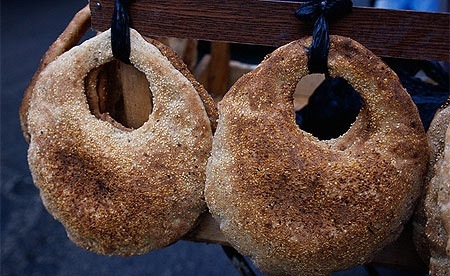
Obwarzanki
Bread rings, brushed with egg white to add shine, are tied together with a string to hang around the neck or wrist. 
  

 Mexico
Paleta de mango
Pierced with a stick, then peeled and scored into sections, the fruit is sprinkled with lime juice, chili powder , and salt.


Germany
Currywurst
Grilled pork sausage is sliced and topped with a few squirts of ketchup, then dusted with curry powder. It's served qith a roll or fries. 


 Brazil
Acaraje
Fritters of mashed black-eyed peas are filled with vatapa, a sun-dried  shrimp puree mixed okra, tomatoes, and cilantro.


Hot Coca

"Yes to coca, no to cocaine." That's the slogan of Evo Morales, Bolivia's first indigeous president, as he battles the 46-year-old United Nations ban on the international trade of coca. Mainly targeting cocaine, the coca plant's infamous derivative, the ban blocks exports from Bolivia, Colombia, and Peru that use the leaf in legal coca-based items - even a soda called Evo Cola. 
 
Morales has politicized the plant's cultural roots, as have manufacturers. "To defend coca is to defend our sovereignty" is printed on bags of coca flour from Peru (right). Long before Europeans arrives, the people of the Andes made ritual offerings of the hoja sagrada, or sacred  leaf, and chewed it as a mild stimulant, - traditions  that continue today.  Modern coca goods give the same lift, much like  coffee, along with vitamins and minerals. The leaf's buzz-producing alkaloids are absorbed only in minute amounts during digestion. Snorting cocaine, however, blasts super-concentrated alkaloids into the bloodstream for what can be a dangerous high. 


From Coca Leaf to Grocery Shelf

Products made with powdered coca leaf cater to many tastes and benefits. A 1975 Harvard study cited the leaf's protein, fiber, and calcium content. Coca leaf is also used in toothpastes, soaps, and skin creams.  


For further information on coca-based food and drinks please visit http://manaintegral.com/mi/ 


                                                                                                          - A. R. Williams, National Geographic, July 2007
 

Monday, February 4, 2013

Kaak: Street Bread in Beirut


food vendors on Avenue de Paris in Beirut, Lebanon. Source: guardian.co.uk, Photograph: Peter Rayner/Axiom


 As I was searching for photographs of life in Beirut, I came across these ones showing food vendors on Avenue de Paris selling kaak. They reminded me of the vendors selling simit in Istanbul which might be the main reason why I liked the photos and the sesame bread in the photos much better. Anyways, a friend of mine traveled to Beirut a couple of months ago and I e-mailed and asked her about this special kind of street bread to see whether she ever ate them. I learned that she had become a fan of them right away and sent me a recipe advising me to give it a try as soon as possible and I did. 


The purse-like bread was beyond my expectations. It came out puffy with a fabulous smell filling the whole house. We gulped them down warm with cheese and yogurt. I sprinkled some za'atar on some of them along with sesame which also contributed a great deal to the overall taste of the bread. I made them in two different sizes. I sent the photos to the same friend and she replied saying that they looked pretty the same as the ones she saw in Beirut. Since it was my first time with such a specific kind of bread, I was so glad with a big smile on my face after getting that feedback.

For more information and photos of kaak, please visit 

http://www.tasteofbeirut.com/2010/01/kaak-street-bread-2/


 Ingredients

1 1/2 cups warm reduced-fat milk
1 tablespoon olive oil
2 cups bread flour
1-2 tablespoons more flour for flouring and rolling
1 cup whole-wheat pastry flour
1 tablespoon sugar
1 teaspoon salt
1 envelope rapid rise yeast

For topping
1 large egg
1/2 cup sesame seeds (1 tablespoon per kaak)

Directions

1. In the pan of an electric bread machine, add ingredients in the order recommended by the yeast manufacturer. Set for the dough cycle.
2. When done, remove dough from pan, cover with a clean towel and let rest for 10 minutes.
3. Divide into 8 equal parts, each weighing about 100 grams. With a floured rolling pin on a floured surface, roll each part into a large, 6-7 inch circle. Use a small, 2-inch glass to cut a small circle out, near the edge of each large circle:
4. Place rings on two greased baking sheets. Beat the egg and 1 TBS water with a fork. Brush each ring with the mixture and sprinkle with about 1 TBS sesame seeds:
5. Cover loosely with plastic wrap and let rise for 30 minutes, or up to an hour.
6. Heat oven to 200°C. Bake about 10 minutes, or until golden and puffed. Serve immediately. 
 

Sunday, February 3, 2013

Grape Molasses - Special to Zile, Turkey


My brother came from Istanbul a couple of days ago with some white grape molasses from Zile which is a district of Tokat Province, Turkey. I had asked him to find the molasses similar to the ones my father used to buy us when we were little kids. He, fortunately, found one which is almost the same - even the box in which they sell the molasses has never changed. The only difference was that the molasses my brother bought is runnier than the ones I remember, but still super yummy. Spread it on a slice of whole grain bread  with a sprinkle of ground cinnamon and enjoy it with a cup of black tea. Excellent!

As to the ingredients in the molasses, it is made of white grapes special to the region of Zile. It is 100% natural product including no additives. It is obtained as a result of the process of condensing grape juice after boiling and mixing it with egg white. It is an instant source of energy since it diffuses into blood quickly and directly with no need to be broken down in the digestive system. Two tablespoons of the molasses (20 g) contains 2 mg iron, 80 mg calcium, and 58 kcal energy. It is an essential product for adolescents, workers, sportspeople, and breastfeeding women.

For further information on grape and other fruit molasses in Turkish cuisine, please visit

http://www.turkish-cuisine.org/english/article_details.php?p_id=2&Pages=Articles&PagingIndex=0


Thursday, January 31, 2013

Flourless Peanut-Chocolate Cookies


 Some friends believe that chocolate and peanuts are a perfect pair for cookies. They always give Snickers as an example with its unique taste and feeling of peanuts and chocolate. However, I am not a fan of either peanuts or Snickers. Anyways, I decided to see whether I like the pairing of those two in cookies and I used Martha Stewart's recipe of flourless peanut-chocolate cookies which was super easy to follow. The cookies came out pretty delicious, but even their great smell,  inspirational look and taste couldn't make me change my mind about them. I am not a fan of either peanuts or Snickers.

Ingredients

  • 1 cup creamy peanut butter
  • 3/4 cup sugar
  • 1 large egg (lightly beaten)
  • 1/2 teaspoon baking soda
  • 1/4 teaspoon salt
  • 3/4 cup semisweet chocolate, cut into chunks
  • 1/2 cup roasted salted peanuts


Directions

1. Preheat oven to 350 Fahrenheit (°F)/176 Celsius (ÂşC). 
2. In a large bowl, using an electric mixer, stir together peanut butter, sugar, egg, baking soda, and salt until well combined. stir in chocolate chunks and peanuts.
3.With moistened hands, roll dough, about 1 heaping tablespoon at a time, into balls. place 2 inches apart on two baking sheets lined with baking paper.  
4. Bake until cookies are golden and puffed, 12 to 14 minutes, rotating sheets from top to bottom and front to back halfway through. 
5. Cool 5 minutes on sheets, transfer cookies to racks to cool completely. 


Wednesday, January 30, 2013

Cinnamon Poached Pears in Cinnamon Cream Sauce


Ingredients

4 medium ripe pears, peeled
3 cups water
1 cup sugar
1 cinnamon stick
1 tablespoon lemon juice
 1-2 cloves (optional)

For the sauce

200 ml heavy cream
1 tablespoon unsalted butter
2 tablespoon sugar
1 teaspoon cornstarch 
1 teaspoon ground cinnamon
1 teaspoon pure vanilla extract

Directions

1. In a pan big enough to hold the pears snugly, tip in all the ingredients except the pears. 
2. Bring to the boil over medium heat and simmer for 10 minutes to infuse.
3. Drop in the pears and gently poach for about 25-30 minutes over low heat until soft. 
4. Turn off the heat and set aside.

*The pears can be poached up to 2 days ahead and kept in the poaching syrup in the fridge.

For the sauce
1. In a small pan, tip in all the ingredients and mix them well. 
2. Put the pan over low heat and bring to the boil. 
3. Remove from the heat.

To serve
Spread 2 tablespoons of the cinnamon-cream sauce on plates. Drain the pears, and holding them by the stem, place them in the sauce.Serve cold.


Pear Dessert by Linda Apple

Tuesday, January 29, 2013

Chocolate Coated Milk Pudding Balls


On Emir's birthday this month, I didn't have enough time to make a special birthday cake for the occasion and I felt so bad about it. You know, you want to make someone happy so much, but you are, unfortunately, not given enough time to produce the thing you've been thinking of. It was such a limited time and I didn't have many options to go for. Anyways, necessity is the mother of invention after all and I  figured a way out - chocolate coated milk pudding balls.

Ingredients

1 litre milk
125 grams butter
1 cup flour 
1 cup sugar
2 teaspoons vanilla sugar

For coating
400 g dark chocolate

Directions

1. Mix sugar, flour and vanilla extract in a bowl.
2. Transfer the mixture into a medium saucepan and add in milk.
3. Stir constantly over medium heat and bring it to a boil. 
4. Add in the butter. Continue stirring. The consistency gets thicker as you stir and the mixture stiffens to be rolled into balls.
5. Keep simmering for another 3-4 minutes.
6. Remove from heat and let it cool down completely in room temperature. Then, refrigerate it at for least 3 hours. As it showed, it's better if you refrigerate the pudding overnight.
7. Meanwhile, melt the chocolate. Please see the video on BBC Food techniques. 
8.  Mold 1  heaped teaspoon of the mixture into a ball and then drop in melted chocolate. 
9. Take the chocolate coated balls gently out and place the balls separately on a tray lined with baking paper.
10. Garnish the balls with walnuts, edible glitter or beads, and crushed cinnamon biscuits or use any other creative idea you can come up with.
11. Refrigerate them again so they get firmer. 


One Sweet World: On the Trail of Chocolate


The cacao tree grows only in the tropics. Yet it's in cooler climes that this plant's beloved product, chocolate, has a voracious following. Europeans lead the pack, with Switzerland, Germany, and Belgium trading off for first place from year to year in per capita chocolate consumption.

Most Europeans take their chocolate in the form of candy. The relatively new concept of selling chocolate in solid form was hatched in London in 1847. Before that, chocolate was for drinking. Probably as early as 1000 B.C., the Olmec were cultivating Central America's native cacao. A thousand years later, the Maya downed shakes of unsweetened chocolate and water. Maya nobles visiting Spain with Dominican friars in 1544 introduced a cocktail of roasted and ground cacao beans, water, wine, and peppers. Sugar was added, and the drink caught on in Europe. 

Chocolate's popularity sparked the spread of cacao cultivation. Trees were imported to the Dutch East Indies in 1778 and Africa in 1822. Though Africa now produces two-thirds of the world's cacao beans , Africans themselves consume little chocolate.  One reason: meltdown. Cocoa butter, the fat of the cacao bean, liquifies near 90°F, making chocolate melt easily in a 98.6°F mouth - or in a hot climate. Candy needs constant refrigeration if it's in a hot place, and most developing countries can't offer that. Additives for heat-resistance  interfere with chocolate's creaminess, so until scientists solve that problem, citizens of cool (or cooled) countries will likely continue as the champion chocolate eaters. 

                                                                                                                    - Margaret G. Zackowitz, National Geographic, April 2004

Sunday, January 27, 2013

Potato and Minced Beef Bake


I came up with this super easy and super yummy recipe a few days ago. If you like meat and potato combinations, you won't regret trying this one. When you give it a try, remember to add one egg or a mixture of half a cup of flour with the same amount of milk. This addition to the mixture would definitely help the bake stick together and hold firmly for slicing. 


Ingredients
400 g minced beef
4-5 medium potatoes, boiled
2 medium onions
1 clove garlic
2 teaspoons finely chopped ginger
1 medium tomato
Salt and black pepper
ground paprika

Directions
1. Heat the oven to 200 °C.
2. Grate onions and chop the onions and garlic finely.
3. Put the beef, potatoes, onions, garlic, ginger, salt, black pepper, ground pepper, and paprika in a large bowl.

4. Mix all the ingredients and line a rectangular baking pan with baking paper. 


5. Slice the tomato thinly and place the slices at the bottom of the baking pan.


6. Transfer the mixture into the baking pan and level it firmly with a spoon.


7. Bake for 45 minutes in 200 °C. 
8. Remove from the oven and let it cool down on a wire rack. Turn upside down on a larger plate or a serving tray. 


9. Remove the baking paper gently.
10. Slice and serve warm.